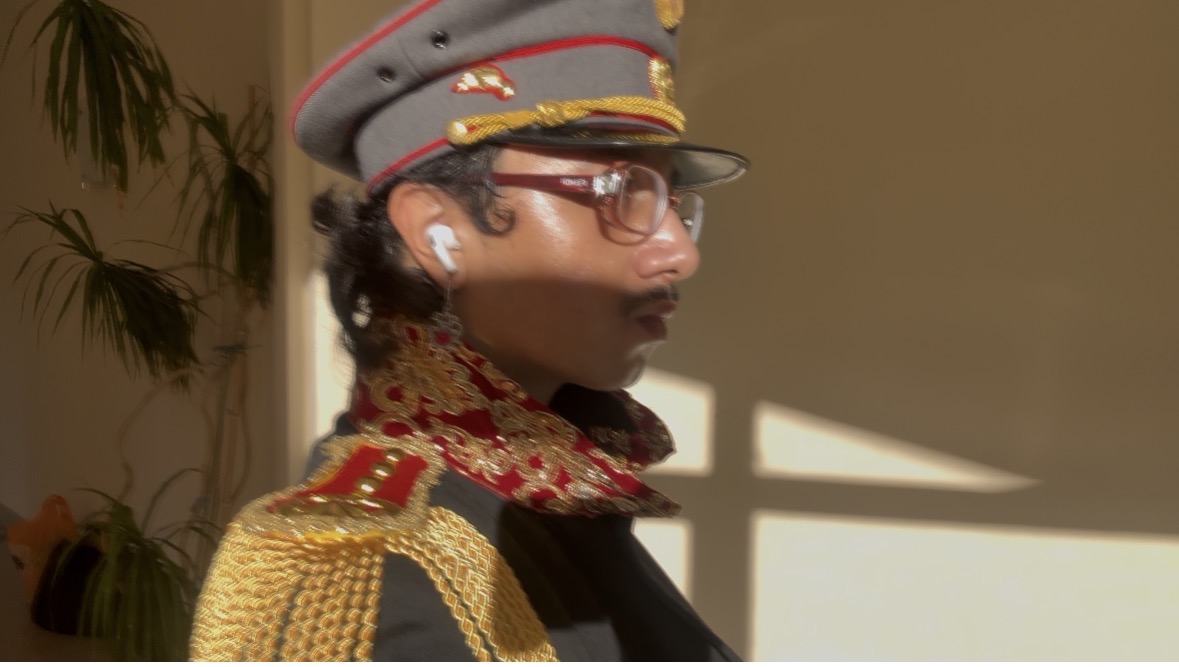
In an original coat recalling the ceremonial military silhouettes of the late nineteenth century, Sado Laurent Gumush considers how clothing constructs authority - and what remains of the individual beneath its symbols.
BY LE SALON DES CONTRASTES - EDITORIAL DESK · NOVEMBER 23, 2026
CURATORIAL INTRODUCTIONBefore viewing
This editorial presents an original coat designed by Sado Laurent Gumush and inspired by the imposing visual language of late-nineteenth-century ceremonial military dress. It considers the psychological relationship between clothing, status and authority. The coat is a contemporary design, not a historical uniform; the accompanying photographs will show the designer wearing his own work.
ARTIST
Design and modeling: SADO LAURENT GUMUSH
MEDIUM
Original coat design / fashion editorial
DATE
2026
THEMES
authority · identity · appearance · historical dress · power
Sado Laurent Gumush wearing his original aristocratic military-inspired coat.
The authority of appearance
Before an order is spoken, authority has often already been staged.
It is suggested through posture, ritual, proportion and dress. A uniform does not merely cover the body. It transforms the person wearing it into a public image, one capable of inspiring recognition, admiration, intimidation or resistance.
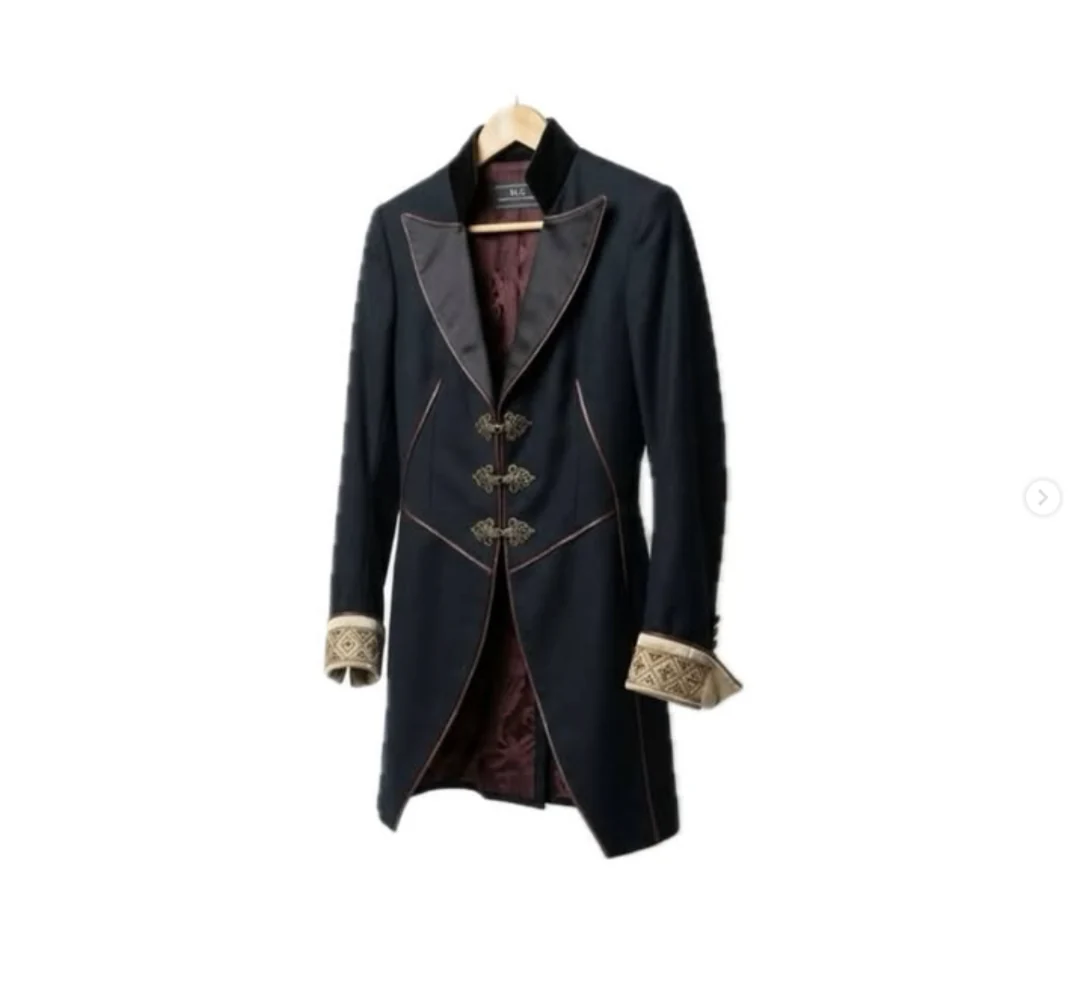
In Le Poids du Commandement, Sado Laurent Gumush revisits the visual language of aristocratic and military dress associated with the late nineteenth century. The coat is an original contemporary design, not an authentic period uniform. Its historical references become a means of asking a distinctly modern question: does clothing express power, or help manufacture the appearance of power?
The architecture of command
A military-inspired coat can give its wearer an imposing silhouette before any word has been exchanged. Its presence suggests discipline and command; its form invites the observer to read a role into a body.
Yet appearance and legitimacy are not the same thing. Clothing may convey rank without proving wisdom, courage or moral authority. The more convincing the image, the more necessary it becomes to question what that image asks others to believe.
The design therefore makes use of historical grandeur without asking the viewer to admire military hierarchy uncritically. Its interest lies in the mechanisms through which an image acquires social force.
The burden of becoming a symbol
Authority is often described as freedom: the freedom to decide, to command and to shape events. But it also carries an obligation to appear worthy of its own symbols.
Gesture becomes ceremony. Uncertainty is hidden. The person risks disappearing behind the image expected of them.
In this sense the garment does not represent only an imagined commander. It also suggests the psychological burden of being seen as one. Who is the individual once the signs of command are removed?
A historical language, a contemporary question
By appearing in photographs wearing his own creation, Gumush brings designer, garment and subject into the same frame. The images become a study in self-presentation and identity, rather than a reconstruction of a specific historical officer.
The coat borrows from the past without belonging to it. Its function in the Salon is not to restore an aristocratic or military order, but to examine the continuing fascination of its visual vocabulary.
The result is a meditation on the difference between possessing authority and appearing authoritative.
A coat may suggest command. It cannot establish the wisdom or moral legitimacy of the person who wears it.
Original design by SADO LAURENT GUMUSH. The photographic series and technical details will be added when the selected images are ready.
The uniform suggests a role; the reflection returns a person. An inquiry into the symbols through which power becomes visible.Inspired by late-19th-century ceremonial dress, the coat reinterprets historical grandeur through a contemporary language of tailoring and identity.A reflection of power, or merely its appearance? The garment explores the distance between the individual and the authority suggested by clothing.Beyond the Ceremony - Sado Laurent Gumush alongside his dear friend Maggie. A moment of companionship that offers a quieter contrast to the coat's imposing historical language, reminding us that beneath every constructed image of authority remains an ordinary human connection.The Person Behind the Uniform - A mirror self-portrait of Sado Laurent Gumush wearing their original military-inspired coat. Between the authority of appearance and the intimacy of reflection, the designer becomes both the observer and the observed.