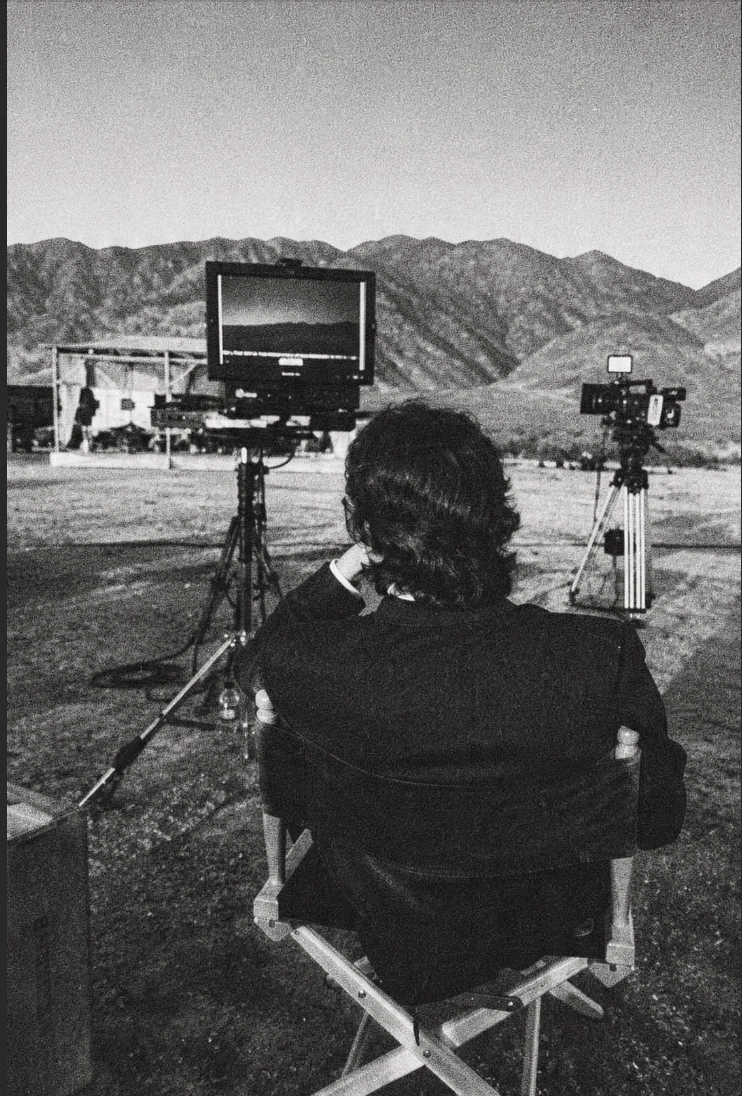
A black-and-white studio image opens a conversation about independent filmmaking, ambiguity and the creative refusal of easy conclusions.
BY LE SALON DES CONTRASTES - EDITORIAL DESK · NOVEMBER 23, 2026
CURATORIAL INTRODUCTIONBefore reading
A third-person editorial piece about the filmmaker’s stated artistic approach. The monochrome director’s-chair image is used symbolically; it should not be read as confirmed on-set documentation for either featured film.
ARTIST
Le Salon des Contrastes / Sado Laurent Gumush
MEDIUM
Studio editorial / cinema essay
THEMES
filmmaking · ambiguity · process
Black-and-white, grain-textured image of a seated figure viewed from behind, facing film equipment and mountains.
A figure sits in a director’s chair, facing the open landscape. There is a camera, a monitor, a suggestion of a production underway - yet what holds the image together is not spectacle. It is the distance between observation and interpretation. This black-and-white image, shared by Sado Laurent Gumush, becomes a fitting visual introduction to his approach to cinema. It is presented here as an editorial image, not as verified behind-the-scenes documentation of a particular shoot.
I. An artistic position
Across his films and published reflections, Gumush has described cinema less as an industry to enter than as a language through which to question existence. His interests lie with psychological tension, memory, ambiguity and the contradictions of human behaviour. Rather than guiding viewers toward a comfortable resolution, his work leaves space for uncertainty and conflicting readings.
I would rather make something that troubles ten minds than something that momentarily entertains ten thousand.
That position is not an objection to audiences. It is an argument for a different kind of encounter - one in which a film may unsettle a certainty, expose a contradiction or complicate the viewer’s interpretation of the everyday.
II. From image to inquiry
The Accident of Being and Quand le monde ne répond pas (When the World Does Not Respond) belong to this developing practice. Their subjects - chance, attachment, memory and the limits of understanding - overlap with the questions explored in the Salon’s research and essays without reducing art to an illustration of science.
Both film pages acknowledge Julie Mudrova as film editor and creative collaborator, and link to the finished work. The Salon treats such collaborations as a meaningful part of the films’ authorship and development.
III. An open archive
The image also marks a beginning for The Notebooks, a space where shorter reflections, fragments of writing, poems and unfinished ideas may appear alongside the established essay and film archive. Announcements of future screenings, talks or cultural gatherings will be published only when details are confirmed.
For the films, visit The Gallery. For the writer’s notes and developing texts, enter The Notebooks.